


I will come out and say it because I know you can’t; most of the copy you receive from your clients sucks! Depressingly, you can build the fastest, most beautiful website in the world, but if the content is terrible it will fail, and all your work will be for nothing.
One option is to send clients on writing for the web training courses before the project kicks off. But how realistic is that? Convincing stakeholders to spend time learning how to do something they already think they know how to do is hard enough. But getting them to cover the cost of you running that training is nearly impossible.
Even if you could persuade them to attend, most of the information would go in one ear and out the other. There is just too much that your clients need to learn to become experts in writing for the web.
So where does that leave us? Do we just give up and accept that all our hard work will be ruined once the site has copy added to it? Of course not!
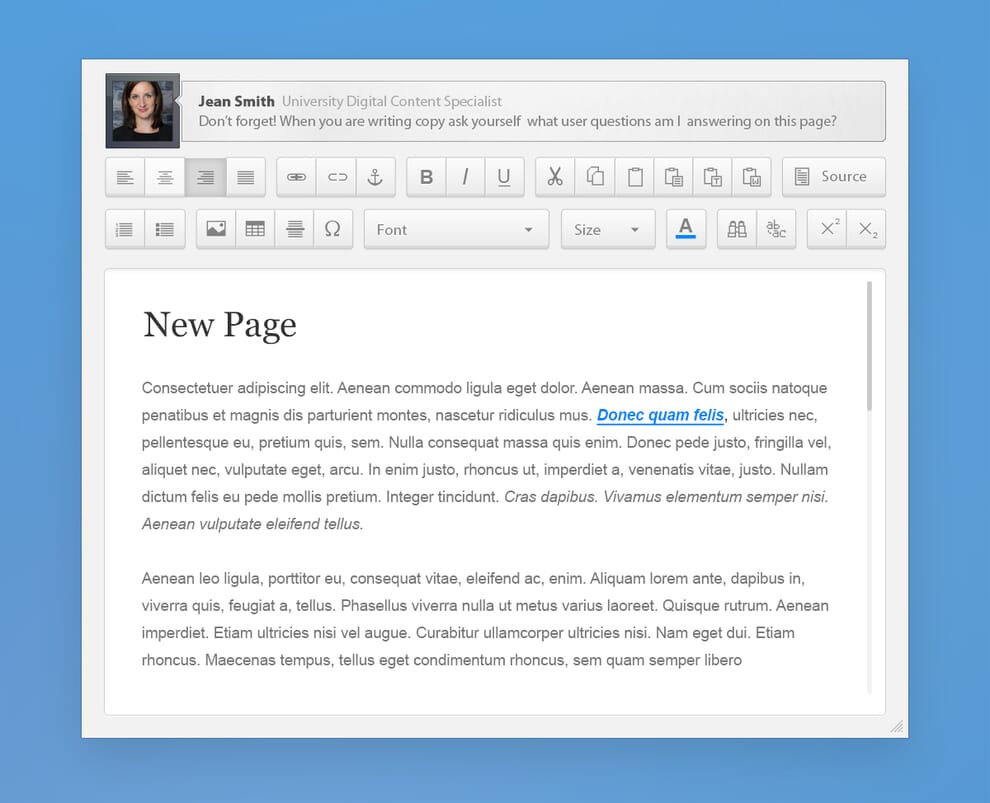
Instead, we need to give our clients a simple anchor point that they can refer to when writing copy. Something that is easy to remember but makes a big difference. In my experience, this boils down to a single question. One so obvious to us that it is easy to dismiss. But a question that cuts to the heart of the problem with most client copy I see:
What user questions am I answering here?
Too often those writing for the web start by asking themselves what they want to say, rather than asking what the user wants to know. That inevitably leads self-promotional copy that mostly ignores user needs.
By just realigning the premise from which the client writes, you dramatically improve the quality of their text. Sure, it won’t be great. It will still be verbose and poorly written at times. But it will be a lot more relevant, and that is the most important thing.
Realign your entire site
You can also use this single question as a way of realigning the entire site, not just a single page of copy. You can suggest that at the very outset of a project you create a large list of top questions through customer journey mapping or empathy mapping. You can then validate these and prioritise them in much the same way you would carry out a top task analysis.
These questions can then pass through a card sorting exercise and become the basis of your information architecture. A site structure built around the user’s questions, rather than internal business silos.
In fact, it is amazing just how powerful that one small question can be, especially if you turn it into a mantra that you repeat throughout the project.


