


We find ourselves at one of those pivotal moments in technological advancement where everything is going to change in a fundamental way. Artificial Intelligence (AI) is not just another “interesting” technology like VR or Blockchain; this one is an absolute game changer.
The AI Revolution Will Be Big and Is Already Here
Bill Gates recently described it “as fundamental as the creation of the microprocessor, the personal computer, the Internet, and the mobile phone,” and he is right.
As with those technologies, companies will rise and fall because of AI. Entire careers will vanish, while new ones will emerge, and our daily lives will change fundamentally.
I use the future tense, but in truth, it has already started. Early adopters, such as myself, are already integrating AI into various aspects of our lives, from improving our health to planning road trips.
More interestingly, we are integrate it into our working lives, from answering emails and reports to analyzing data or creating presentations.
As Bill Gates added on twitter “It will change the way people work, learn, travel, get health care, and communicate with each other.”
Soon, it will change pretty much every activity humans do and, by extension, every organization and business.
We are looking at another digital revolution, but this time, much, much faster. Your digital transformation strategy that took years to implement is not going to cut it this time.
The Speed of AI Adoption and the Need for an AI Strategy
You might believe I am exaggerating. However, history shows us I am not. Each new technology, from the automobile and the telephone through to the internet and smartphones, has been adopted faster than the last.
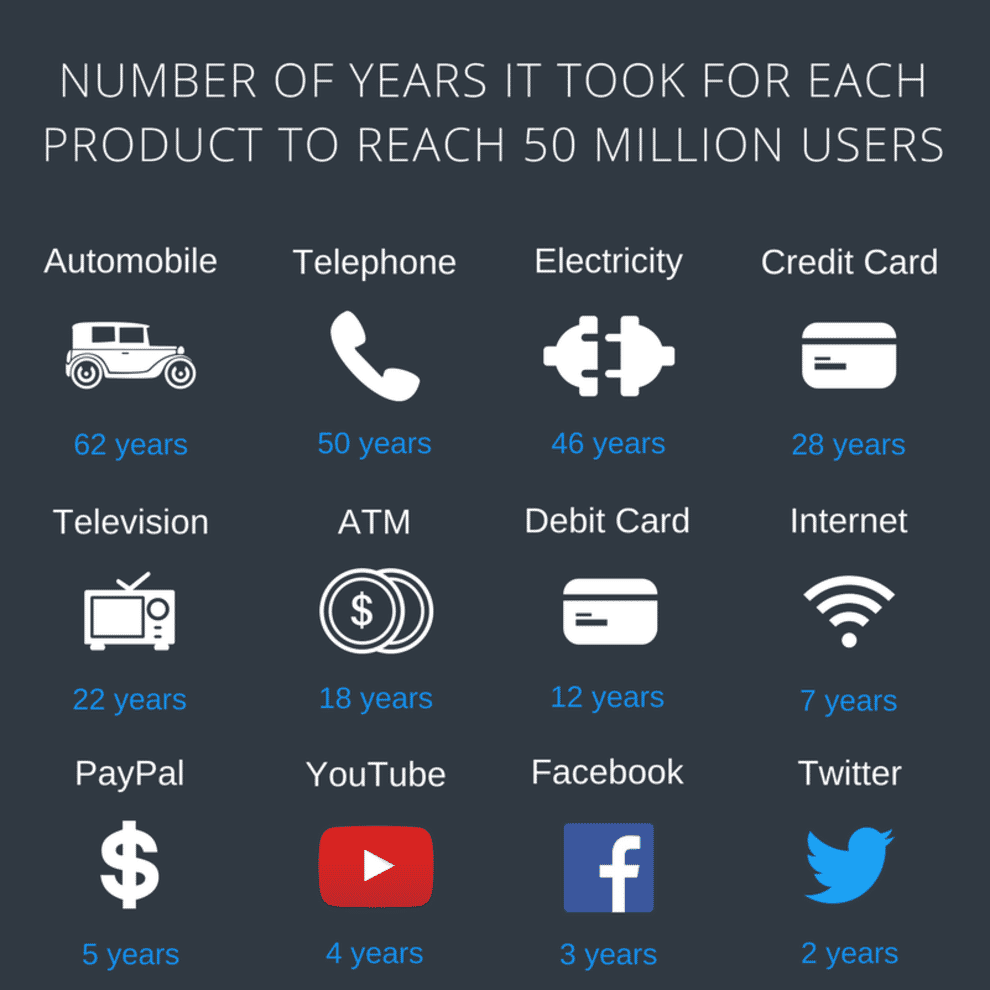
However, you can expect AI to be adopted even faster than usual because, unlike other new technologies, the barrier to entry is so low.
While most technology has a steep learning curve in the early days, anyone can use AI right now as long as they know how to type! Additionally, the fact that access to AI is currently free means we are already beginning to see widespread adoption.
The only limits to AI adoption by people and organizations are their imagination.
All of this is to say that organizations and individuals need to act now if they want to survive this tsunami of change! Yes, I know this sounds like fear-mongering, but I don’t think I am exaggerating and I see it as an incredible opportunity, not something to fear.
Navigating Uncharted Territory
As organizations, we need an AI strategy, and we need it now. So where should you begin in creating an AI strategy? Well, there is no handbook for this, no AI strategy template or framework. We are in new territory here.
What we do know is that we cannot use traditional business strategy approaches. We cannot afford to form working groups, have endless meetings, and go through large consultation processes. We have to be more agile than that. We just don’t have the time.
Appointing an AI Strategy Leader
First off, you need somebody who is going to take point on this. Someone who can carry out some initial research and identify various projects that will be needed to help the organization adapt.
Your initial reaction might be to use an outside consultant for this, and that is an option. But be careful. Things are moving so fast that the traditional big players like Ernst & Young, Accenture, and KPMG are struggling to keep up. There are few genuine experts in the field, and I would be suspicious of anybody who claims to be so. I wouldn’t make that claim about myself despite having explored AI in considerable depth.
Secondly, it is easy to get bogged down in procurement and contract negotiations, which could easily stall the review before it begins. Speed is of the essence with AI strategy and adoption.
Understanding AI Capabilities and Future Developments
Once you have your person, their first job in creating an AI strategy is to ensure they have a reasonable handle on what AI is capable of. “Reasonable” is as much as you can hope for at this stage as things are moving so fast. Last week alone, we saw new versions of Chat GPT and Midjourney, as well as announcements by Microsoft and Google that they would be integrating this technology into their office suites.
This also highlights the need for this person to be “reasonably” up to speed with what is coming down the pipeline. For example, your organization and its employees need to be prepared for when Microsoft suddenly drops a load of AI tools on you through its office products.
Conducting Quick and Dirty User Research
The next step in creating an AI strategy is to establish how these tools could support or threaten organizational activities. This is where it is time to carry out some quick and dirty user research.
I would recommend a mixture of surveying and employee interviews to understand what kind of jobs people are doing that could be impacted by AI. Broadly speaking, you are looking to establish:
- What people are writing.
- What media people are creating.
- What data people are analyzing.
As these are the biggest areas of AI advancement at the moment.
The result of this research will give you an indication of what impact AI could have on operations as they stand today. Some kind of threats and opportunities analysis would seem the logical outcome.
I use the word “seems” because I don’t know. Nobody does because nobody has had to do this before. We cannot apply an off-the-shelf solution here.
Analyzing Threats and Opportunities
What you are looking to end up with are two lists.
First, we want a list of threats where AI is in danger of either fundamentally disrupting or destroying existing business models or processes.
Second, we need a list of opportunities AI provides to be more efficient or move into new areas.
With that done, I would probably recommend identifying a series of projects that could explore each of these opportunities and threats in more depth.
Balancing Technical and Cultural Change
Some of these projects will be technical in nature, such as adopting a new piece of technology, but a lot will involve training staff or even encouraging cultural change.
Be careful you do not fixate on the technology. I see too many “IT projects” rolled out that fail because of a lack of training and adoption. It is how the technology empowers employees and customers that matters.
Prioritizing AI Initiatives with Triage
The chances are you will identify a lot of projects as part of your AI strategy. More than you will be able to tackle as an organization in a timely manner, so you are going to have to triage the challenge.
The danger at this point is that the organization goes into panic mode, trying to address too many of these initiatives simultaneously. I have seen that time and again with digital transformation initiatives, and I see no reason this would not go down a similar route.
The problem with kicking off that number of projects simultaneously is that it will slow overall progress. Projects will be plagued with interdependencies, and resources will be overstretched. The result will be that a large number of person-hours will be sunk into “AI adoption and implementation” without any single initiative getting over the line and generating a return for the business.
Instead, you should seek to create a backlog of initiatives that need to be undertaken ordered based on a triage system, which I would establish as part of your AI strategy roadmap.
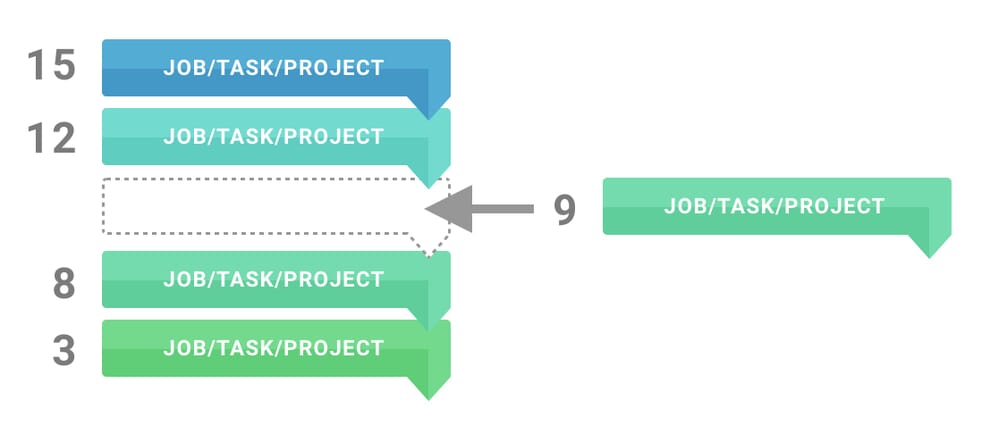
I have written about triaging before. Essentially we are seeking to assign a points value for any AI-related project that establishes its position in the backlog. The more points a project has, the nearer it will be to the top of the backlog, and the faster it will be implemented.
This also allows for change. As a new AI capability emerges, this will create new potential projects. But instead of these ending up at the bottom of the list, they can be assessed and then slotted into their appropriate position in the backlog based on their points value.
Simplifying Assessment Criteria
In terms of how you point potential projects, I would recommend keeping it simple. The more complicated the assessment criteria, the longer it will take. Remember, speed is essential.
Maybe five simple criteria with a one-to-five rating might be enough. Something like:
- Overall organizational benefit – To what level would a successful implementation of the project benefit the organization?
- Effort to implement – How complicated is the project to develop, and what are the associated costs?
- Effort to adopt – How easy, or otherwise, will it be to roll the project out, and how likely are you to see widespread adoption?
- Customer benefit – What benefit, if any, will this project have for end-users?
- Ongoing support – What level of ongoing support will this project require, and are the appropriate resources in place?
You will need to customize this to suit your organization, but be careful of over-engineering. Keep it simple.
Implementing Projects in Order of Priority
Once you have your backlog in place, you can start working through the projects in order of priority. As I have already said, resist the urge to take on too many projects simultaneously.
Instead, only take on multiple projects if you have completely separate teams working on them, and even then, only if they are completely independent from one another.
Try to avoid interdependencies at all, even if that means implementing a less than perfect solution. In fact, avoid perfection generally.
Embracing Iterative and Agile Project Management
Organizations have a tendency to undertake long and detailed specification phases at the start of projects in an attempt to nail down all the details and implement the best solution possible.
This makes perfect sense if you are building a factory where a mistake is enormously costly. However, it can be harmful for digital projects, especially when things are changing so fast.
If you use traditional project management processes within your AI strategy, I can almost guarantee that once an AI project goes live, it will already be out of date. Instead, you need to adopt an iterative approach where you implement quick and dirty solutions initially that you incrementally improve over time.
I would also favor pilot projects initially rather than widespread rollouts. This will give you time to refine your approach and iron out the kinks. This will reduce costs and also the likelihood of employees rejecting the solution.
Ensuring Long-term Support and Optimization
Finally, think carefully about long-term support for any of these AI technologies you adopt. Organizational tendency to think in terms of finite projects can be dangerous when it comes to digital, especially with technologies that are continually improving like AI will be for some time to come.
The danger is that you will reach the end of the project, and the people, money, and resources will be redirected elsewhere. However, when this happens, the deliverable doesn’t get optimized, meaning it is never as effective as it could be, and it quickly becomes out of date or even redundant.
It is maybe better to position AI projects as AI services within your AI strategy. An ongoing commitment to offer AI services that can aid employee productivity, improve user experiences, and increase organizational effectiveness.
So that is how I would approach an AI strategy for one of my clients. But let me be honest, I don’t know. Nobody does. This is all so new. We are all trying to keep our head above water in this tsunami of change.
That said, we will have to work something out because this is coming whether we are ready for it or not. Perhaps my experience with digital transformation will help, or perhaps it won’t. I will have to see.
AI Consultancy Clinic: An Invitation for Help
However, if you believe you need help in this area and think I might have something to offer, please feel free to drop me an email.
Alternatively, I am getting so many inquiries about AI that I am offering an AI consultancy clinic. A one-hour meeting that you can book online now where we can explore the possibilities around AI for your organization. It might make a nice small initial step to start thinking all of this through. The offer is there if you want it.


