


Ask most senior management teams where the future of their businesses lie, and you can pretty much guarantee that customer experience and digital technologies will be near the top of the lists. Yet, to say that organisations are underinvesting in training around these areas would be an enormous understatement.
UX and digital teams are so busy implementing digital projects that the last thing on their minds is training others, while HR departments seem to be making half-hearted efforts at best.
The result is that in most organisations, digital professionals and UX specialists have become an enormous bottleneck, typically massively overstretched and under-resourced for the enormity of the work to be done.
Worst still, they are only addressing a tiny part of the customer experience and a fraction of what could be possible through digital, because others across the organisation are making ill-informed decisions about what is possible or desirable.
If organisations are to become truly customer-centric, or for that matter, to actually digitally transform, they need to ensure all employees have a basic understanding of digital best practice and user-centric thinking. To do that organisations need a robust and effective training programme; one not reliant on sporadic in-person workshop sessions.
The Problem with Digital Training
With only a few exceptions, the majority of digital or UX training I see in organisations consist of the occasional workshop or lunchtime presentation. There is no structured programme of education and little in the way of on-demand, virtual training.
The result is that any knowledge people receive is quickly forgotten unless they are immediately and regularly implementing what they have learned. This approach does nothing to change how people work or company culture.
Then there is the fact that it can be hard to get everybody at training events, meaning that many miss out, not to mention the fact that training will need repeating as new staff join.
Finally, all too often, this kind of training has the wrong focus. Often training focuses on new technology and how to use it, rather than helping people adopt a user-centric mindset and digital ways of working.
So far, my focus has been on training that happens in-house. However, often organisations choose to send staff on public training courses, and these have additional issues. Not only can lessons be forgotten, and training needs to be repeated, but it also suffers from being generic.
I provide public training myself, but I am aware that its usefulness is limited compared to the training I do in-house because it does not take into account the specific challenges that are unique to each organisation. Yes, you can learn best practice on a public workshop, but the challenges are applying those best practices in your particular circumstances.
All of this is to say that it is not enough to run the occasional in-house workshop or send employees on a public training course once in a while. If your organisation claims to be committed to digital transformation or improved customer service, then they need a more robust training programme.
An On-Demand, Virtual Training Approach
Over recent years my primary focus has been on improving the capabilities, experiences and knowledge of organisations in fields like user experience, digital transformation and conversion optimisation.
Over that time, I have found that the most effective ways of doing this are to adopt a blended approach, combining multiple techniques to overcome the problems that I have outlined so far.
These techniques are primarily built around self-paced learning combined with virtual training. However, I do not do away with interactive workshops entirely as I believe they do have value in certain scenarios.
Let’s look at the various techniques I recommend adopting.
Self-learning courses
At the heart of my approach lies self-learning courses. I favour these because it allows staff to learn at times convenient to them and at their personal pace.
These courses can combine video, audio, imagery, text and interactive elements to maximise retention. They can also make use of analytics and quizzes to ensure staff have completed and understood the exercises.
Self-learning courses are ideal for onboarding new staff and for teaching employees best practice in areas like UX, writing for the web and digital strategy to mention just three.
However, these longer form self-learning courses can also be supported by shorter how-to guides.
How-to Guides
While a self-learning course focuses on broader topics, how-to guides are practical short tutorials for completing common tasks such as adding content to the website or looking up information in analytics.
In our personal lives, we have got used to using the web to look up how to complete all kinds of common tasks such as unblocking a drain or resetting our iPhone. It, therefore, makes sense to create a repository of similar work-related tasks that empower employees to address their own problems without adding to the workload of a central UX or digital team.
This repository can start small and grow over time simply by documenting answers to the questions these teams commonly get asked.
You can even create these how-to guides for simple activities that the UX and digital teams have to carry out regularly for colleagues. This empowers others to do these tasks for themselves.
Of course, these how-to guides and self-learning courses need a home, and that is where a playbook comes in.
UX or Digital Playbook
A playbook (sometimes known as a service manual) is a repository of material that will help employees within an organisation better approach digital and creating a compelling user experience.
It typically consists of a mixture of educational material, policies and standard operating procedures. Some examples might include:
- A set of design principles.
- Stages of a digital project.
- Guide to writing for the web.
- How to run a usability test session.
- Accessibility policies and procedures.
However, the list can become extensive as you can see from the UK Government’s Service Manual.
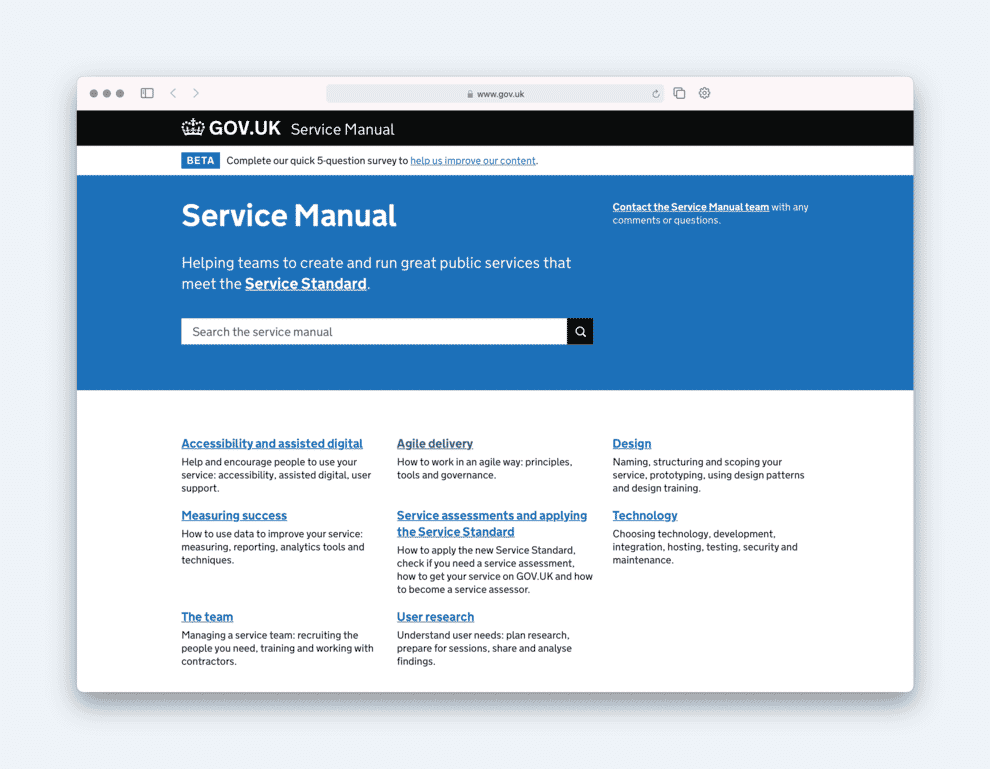
Because of the enormity of the task to create a comprehensive playbook, many organisations are put off of trying. However, you can start small, focusing on the critical information that employees need. A simple starter playbook normally takes me approximately a week to put together.
So far, we have focused on self-learning material. However, the best training strategies adopt a blended approach, including real-time training too. For example, I am a huge proponent of virtual surgeries.
Virtual Surgeries
Surgeries are where an employee within an organisation has a one-to-one session with a digital or UX expert to address the specific challenges they face in their job. Sessions like these have the advantage of tackling real-world problems, rather than the more generic material found in a self-learning course.
However, surgeries do still offer a significant educational component. Done right, the expert does not just solve the problem for the employee, but rather teaches them the process for finding a solution.
The emphasis of surgeries should always be on knowledge transfer. They are about empowering people to fix their issues, not the expert fixing them on their behalf.
This is an approach I have adopted with the likes of GSK, Centrica and the University of St. Andrews, and it has regularly been considered the most valuable part of a training programme.
Of course, the problem with surgeries is that they are hard to scale. That is why interactive workshops will still have their place in training.
Interactive workshops
You would be forgiven for thinking that I’m not too fond of workshops based on how I started this post. However, that is not the case, and I still run a huge number of them. I believe that they should be a part of a broader suite of training.
When they are used in that way, they become invaluable; especially when that training is focused on different roles within an organisation enabling the workshop to address the challenges faced by that role.
For example, it would be easy to run a workshop on writing for the web that is open to anybody who produces online content. However, the real value is in working separately with marketers, compliance people and other groups who all have different needs.
Also, I believe that these sessions should be less focused on teaching and more focused on doing. Teaching can be delivered using self-learning courses and playbooks. However, what these channels cannot allow is interaction with colleagues. That is why workshops are so valuable when it comes to creating together. Whether that is mapping the customer journey or building a prototype, the focus of workshops should be on learning through creation.
The Benefits of Getting Training Right
I am conscious that the kind of training programme I have outlined here is a big investment of time and energy. However, it is essential to an organisation’s long term success in digital adoption and improving the user experience.
At the moment, digital and UX teams are a bottleneck preventing organisational growth in these areas. Knowledge is held exclusively in these teams, and they do not have the capacity to deliver everything an organisation needs to do.
Even if they could, we will have just succeeded in creating another organisational silo, which undermines the success of customer experience initiatives.
A training programme like the one I have proposed above disseminates the ability to deliver in UX and digital across all of the organisation. This enables the organisation to move to a hybrid approach, where the central team acts as a coordinator, rather than exclusively implementors.

This approach has other benefits too. For example, it will increase the likelihood of digital projects running more smoothly because all those involved are better informed: no more unrealistic expectations or consistent underinvestment.
Finally, and in my opinion, most significantly, a training programme of this nature will have benefits far beyond digital and UX projects.
Digital has introduced a lot of new ways of working that are more agile and adaptive. Methodologies that are applicable in all areas of an organisation from how they run projects to how they communicate with their customers.
Unfortunately, too many UX and digital teams are caught in a catch 22. They don’t have time to implement a programme of training because they are currently the only source of knowledge about UX and digital in the organisation. They cannot free up more time to design a training programme because they are too busy implementing digital projects for others.
One solution to this problem is to outsource this work. That is how I have been helping dozens of organisations in recent years. If I can help you too, get in touch. I would love to do the same for you.


