


The way we collectively approach website RFPs is broken. Yes, it is fundamentally the same approach that we use for every kind of request for proposal. However, in the case of digital, it is not fit for purpose.
A website RFP usually comes into being when somebody in senior management decides the website needs redesigning. Stakeholders are then assembled, and some discussion occurs about the role of the website before the conversation quickly moves on to what the website should do and what content it needs to include.
A document is then drawn up outlining the required functionality, and this is sent out to prospective suppliers who are required to bid on how much the project will cost to deliver.
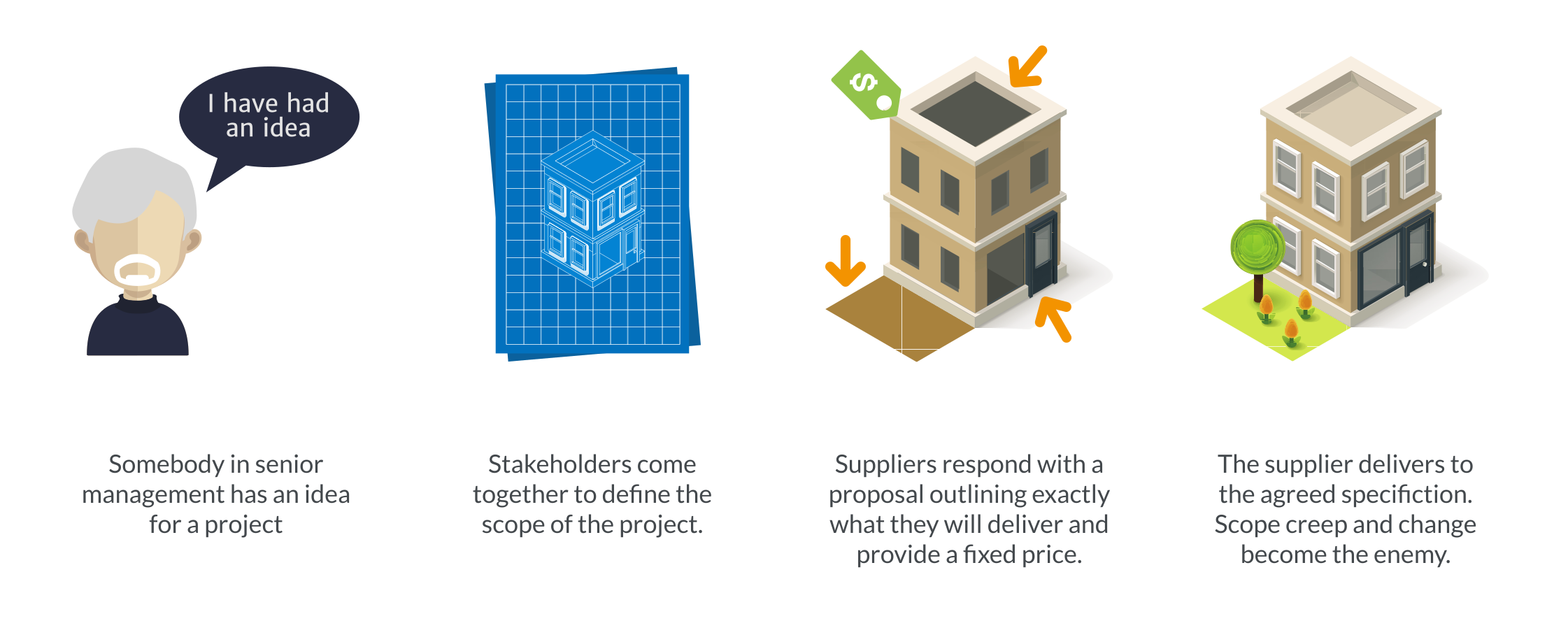
It is an approach that comes with inherent flaws, especially for digital projects.
Why Digital Projects Suffer From the RFP Process
The current RFP process is far from ideal for any project, not least because it often involves the client defining the solution they want to see when often they are not placed to do that. After all, it makes no sense to hire an architect to design your house and then yet set so many requirements that you have effectively designed it yourself. Yet, that is what all too often happens with RFPs.
Unfortunately, the current RFP process is even less suited to digital projects than it is to a physical project like building a house. That is because digital has two fundamentally different properties.
First, the raw materials of digital projects are free. Pixels do not cost anything. The highest cost for any digital project is person-hours, not raw materials. It would be disastrous to get halfway through a house build and then change direction because of the capital sunk into building supplies. However, it would be considerably less harmful on a digital project.
Second, digital provides us with unprecedented amounts of data in terms of how the end-user will interact with it. Through testing with users, prototyping and minimum viable products, we can gain insights that allow us to optimise the project’s final deliverable and guarantee it provides as good a return on investment as possible.
Unfortunately, the majority of RFPs negate the advantages of digital by insisting upon tying down the exact deliverable and costs upfront.
The result of this approach is that scope creep is the enemy. Neither the client nor supplier will be willing to adapt the deliverable based on user feedback, data, or lessons learned during the build, even though the cost of doing so is relatively low and the potential return on investment high.
How then should we create a website RFP in such a way as to make full use of the potential of digital?
How a Website RFP Should Be Written
To answer that question, let’s be clear about what we need from a website RFP. We need it to be:
- Flexible, so that we can adapt the scope based on user feedback.
- Focused on the objectives rather than the site’s features, so we can utilise the full expertise of the supplier in suggesting approaches.
Do you need help writing or responding to a website RFP?
Then get in touch.
However, we also need to be realistic. We cannot expect management to write a blank cheque to a supplier, so it still needs a budgetary constraint.
So with that in mind, a website RFP should contain:
- The objectives you want to achieve.
- Your budget.
- Suggestions about how those objectives might be achieved.
- Questions for prospective suppliers to respond to.
Let’s look at these in more detail, starting with your objective.
Outline Your Objectives
A website RFP must not jump right into solutions. Clients should take a step back and begin by outlining why they want to run the project. What are they hoping to achieve?
Do they want more leads, more engagement, or higher profile, etc.? It will then fall to the supplier to come up with the best way of achieving that objective within your budget.
For example, a client may want to increase the number of leads they receive. In their minds, they had imagined that redesigning the website would achieve that outcome. However, the supplier might have a better idea. Perhaps they will turn to email marketing or a blog.
That gives the supplier a chance to impress the client by coming up with a way to meet or even exceed the client’s objectives and do so for less money than the client expected.
Talking of money, the website RFP must talk about the budget.
Include a Budget
Many website RFPs don’t specify a budget for the project, which makes the job of the supplier almost impossible.
It is the equivalent of going to a real estate agent and asking them to show you four-bedroom houses without telling them how much you can afford. They won’t know whether to show you exclusive detached beachside properties or a rundown terrace house in a high crime area.

Of course, the client may have no idea how much the kind of website they want will cost. However, that is looking at it the wrong way. The client needs to ask themselves how much the business can afford to invest to achieve the objective they want.
The more they invest, typically the better chance they have of meeting or exceeding their desired objective. For example, if you gave me a few hundred dollars to generate more leads, I could do it. However, if you gave me a few tens of thousands, I could generate many, many more leads.
The more the client invests, the greater the return they will see.
That said, there will be business constraints that prevent an unlimited budget even if it would guarantee a limitless return (which it cannot). No project can guarantee a return so ultimately the budget comes down to how much investment they are willing to risk. The website RFP should outline this.
All of this focus on objectives and budgets isn’t to say that the client cannot make suggestions about what approach they had in mind.
Suggest Solutions
Writing a website RFP that makes no mention of deliverables (such as websites or email campaigns), will lead to a vast range of different proposed approaches. That will make it extremely hard for clients to compare different proposals.
It also leads to the possibility of the supplier proposing a solution that is not viable for an unseen internal reason.
With that in mind, the client should feel free to suggest possible solutions they had in mind. If they have in their heads that the supplier would deliver a redesigned website built on a new CMS with ecommerce functionality, they should feel free to say that.
However, what is crucial is how that is positioned in the website RFP. It needs to be framed as a suggestion for solving the objective, not as a requirement for selection. The supplier should feel free to suggest a completely different approach to achieving the overall objective.
What matters is delivering the objective within budget, and the supplier needs to demonstrate they can do that. To help them prove that to the client, the client should also include some questions for the supplier that would help reassure them about the supplier’s ability to deliver.
Questions for Suppliers
I often find that the questions asked in a website RFP are not the best for selecting the right supplier. For example, many seem to put an emphasis on experience in the sector, when that rarely has a significant impact on a suppliers ability to deliver. Yes, it helps, but a fresh perspective can often be a good thing, even if it means a steeper learning curve for the supplier.
Instead, the questions for suppliers in your website RFP needs to help the client understand the following:
- Do they have a proven process for delivering results?
- Could you work with these people and will you enjoy the experience?
- Will this company be able to support you for the long-term?
Exactly what questions the client asks, will depend on the website RFP. However, typically they are around areas such as:
- The supplier’s process.
- The supplier’s financial stability and how long they have been in business.
- How they support existing customers.
- Previous work they have done.
- What their customers say about them and whether you can speak to those customers.
A good set of questions, combined with a focus on objectives, budget and a more open attitude towards solutions, will result in much better responses to your website RFP.
However, you can often meet internal resistance to this more flexible approach.
Overcoming the Internal Barriers to a Good Website RFP
You will encounter all kinds of reasons why colleagues will want to issue a more traditional RFP; from procurement rules to incompatible internal processes.
However, in most cases, it comes down to a natural resistance to doing things differently, which is a problem that cannot be solved overnight.
One workaround is to split your website RFP into several smaller projects.
For example, let’s take a typical website redesign. That could be split into four smaller projects.
- A discovery stage. The supplier could carry out any user research to better understand what the project needs to deliver. It could also do any competitive analysis required.
- A prototype stage (Alpha). The supplier produces a visualisation of the final deliverable based on the results of the discovery phase.
- The Build (Beta). The prototype could act as the functional specification allowing for a fixed price build project.
- Ongoing support. This stage would encompass any post-launch iteration of the site and general maintenance.
By splitting down the website RFP into four smaller projects, it allows the client to:
- Limit its risk by allowing them to trial a supplier without committing to a massive and potentially expensive mistake. They could easily change the supplier between each project if the relationship weren’t working. That makes it popular with procurement teams and management.
- Adapt the deliverables and scope between each stage, while still allowing a fixed price project for each step.
It also has the advantage that each project may fall under your procurement threshold, reducing the red tape involved in selecting a supplier.
Although not as flexible as a fully agile project, it is a step that many organisations find much more palatable, and suppliers should love.
But what if you are one of the suppliers who want to encourage clients to adopt a more flexible approach in their website RFPs?
How Web Design Suppliers Should Respond to a Bad Website RFP
There is one important thing to remember if you run a web design agency — Just because you receive a website RFP doesn’t mean you have to respond to it “as is”. You can suggest alternative approaches.
By way of example, I recently received a very traditional website RFP for a substantial project. It was big, complicated, and I didn’t have a clue about how to respond appropriately. There were just too many unknowns.
However, instead of walking away, I arranged a call with the client and talked about the challenges through with them, before proposing an approach not dissimilar to what we have discussed here.
It turns out the client had not written a website RFP before and was grateful for an alternative perspective. I went from being “just another supplier” to standing out from the crowd because I was willing to suggest a better approach.
One of the most common questions I get asked by the agencies I coach is how to more accurately price projects. That is because in most cases, people are being asked to quote without enough information.
My answer is therefore always the same, break the project down into more manageable chunks and quote on each piece as you reach it. But to do that we need to be willing to discuss a website RFP with the client, rather than seeing it as set in stone.
Always remember, whether you are a supplier or a company looking to commission a new website, a website RFP should be a tool for ensuring the best results possible, not a binding contract that defines every detail of the project.


