Hello again.
Do you have a big idea? Maybe it is a digital product or a software as a service platform? Maybe its for yourself or maybe it is something you want to implement for your employer?
In my experience, most of us who work in digital have a big idea. But the trouble with big ideas is that they are a gamble. You could sink hours of your time and potentially a lot of your money into developing your big idea only to see it fail.
And when you need somebody else’s money and permission, it gets even harder as you have to convince them to take the gamble.
But, what if you could know with certainty whether your big idea was going to be a success before you go to the cost of creating it? What if you could prove to yourself, your boss or your client that it would work?
This week is your last chance to grab a ticket for my upcoming workshop on building websites that convert. In the online sessions, we are going to look at:
- the role of psychology in conversion,
- how to create a compelling offering,
- how to shape a user’s perception through good design
- and the role of testing in conversion optimisation.
Why Your Big Idea Is a Gamble
The problem is that the way we approach our next big idea hasn’t changed much since the beginning of the twentieth century. Somebody (generally in senior management) comes up with an idea for a new product or service, and a plan is formed in conjunction with various other stakeholders for implementing it.
Then the plan is put into action before it is finally launched. Only once it is launched will you know if the product is successful or not. It is an enormous risk, and these days it is just not necessary.
Digital has changed the game in two ways. First, it gives us never seen before access and information on our target audience. Second, it allows us to adapt much faster and experiment with different approaches. In short, digital allows us to test our ideas before we go to the expense of implementing them.
The Problem with Doing Market Research
Of course, testing a market is not a new concept. Companies have been doing market research since the 1920s. However, market research has two significant limitations.
- First, it is time-consuming, and if all it does is confirm that an idea is good, then that can feel like wasted time. As a result, most organisations do little or no research, preferring to take the gamble.
- Second, market research isn’t always very accurate. People will often express an interest in a product or service, but behave very differently when they come to buy in the real world.
How to Test Your Big Idea
However, digital offers a new way to test, that addresses both of these problems. It will allow us to realistically test the market, while effectively preselling our big idea and building an audience hungry for it to launch.
So how do we achieve this? Instead of starting with the product, we start by building the sales funnel. In effect, we sell the product before we create it. If it sells, we know we have the next big idea. If it doesn’t, we can go back to the drawing board with little lost.
Like all good ideas, the implementation is remarkably simple. Instead of starting with creating the product or service, start with how to sell it.
Start by Selling Your Product
Work out your value proposition, benefits and features. Then create a small digital presence (often referred to as a landing page) promoting the offering. ‘Sell’ the offering on the landing page as if it was a real product, right down to the buy button.
Now drive traffic to your landing page, just as you would once the product has launched and watch what happens.
If users hit that buy button, you can inform them that the product is not quite ready and then offer one of two options. Either you let them sign up to a waiting list or allow them to preorder (with payment not being taken to launch).
Allowing people to preorder is a more realistic representation of their willingness to buy than signing up for a waiting list. However, whatever you decide, by monitoring just how many people hit that buy button, you get to see what your conversion rate will likely be.
Learning Through Selling
This approach is a lot more realistic than market research because you are asking users to take concrete action, not just express theoretical interest. Also, at a minimum, you are building a list of customers who expressed an interest in buying for when you do launch.
You can learn from those who don’t order as well. Just before users abandon the website, you can display a single question survey that asks them why they decided not to purchase. This knowledge will allow you to iterate upon your landing page and even the product idea itself, before driving more people to the page and see if that helps improve conversion.
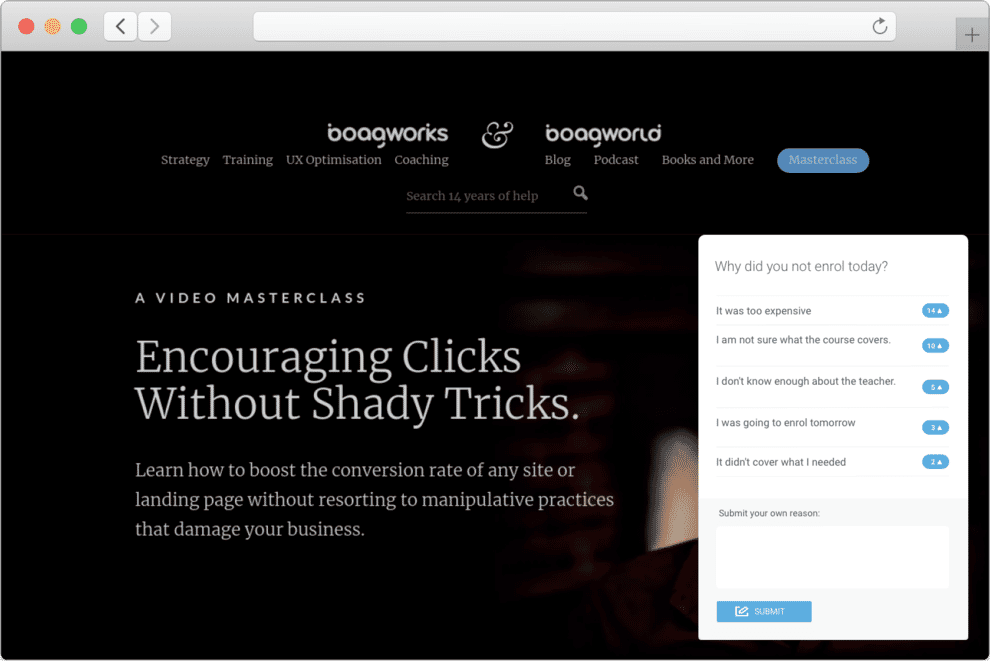
In this way, you can not only validate your big idea, but you can also optimise it so that its conversion rate is as high as possible, all before you commit to the expense of developing the product itself.
So before you start on that next side project or even roll out that new product at your company, consider preselling through a dedicated landing page and online sales campaign. You will end up with a better product that you are more confident in, plus a list of customers hungry to buy. What is there to lose? You have to create that landing page and sales campaign eventually anyway.
And if you want to make the sales page as compelling as possible, you should join me for my workshop on “creating websites that convert” starting on the 18th. We can even create that landing page together.
Speak to you soon!