I recently saw this cartoon posted on Twitter, and it made me laugh out loud.
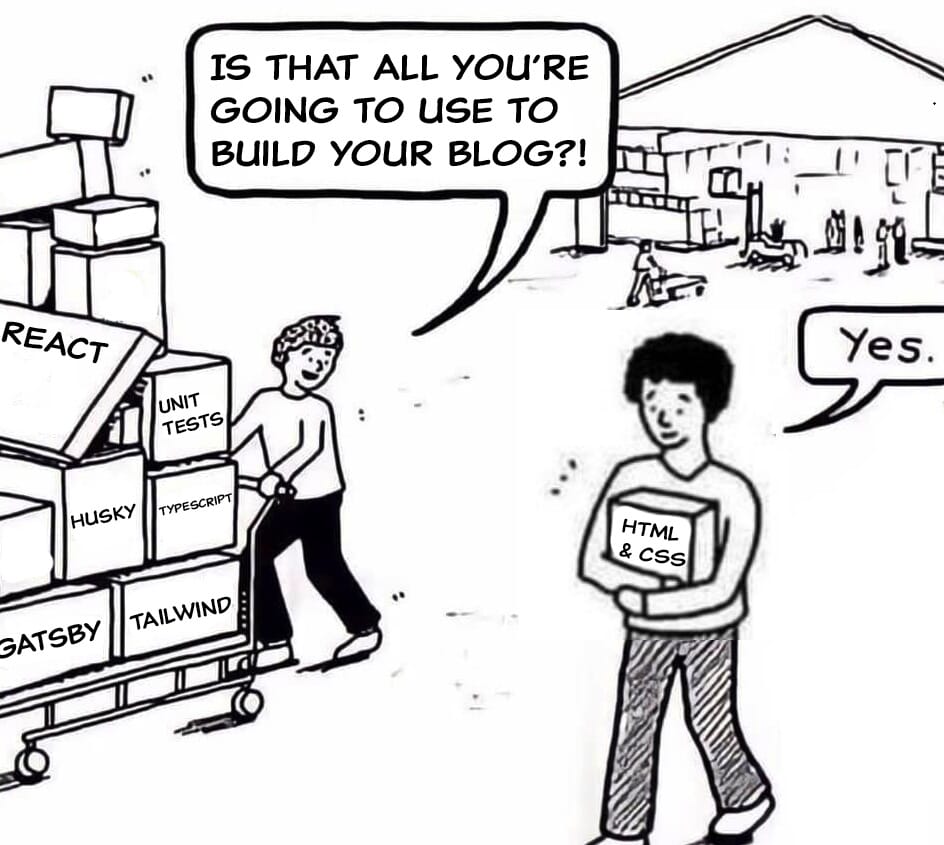
Unless you are an old-school developer like me, it may be somewhat lost on you, so let me briefly explain. And don’t worry if you are not a developer at all. This is still very much relevant to you.
There is a trend among developers to use a variety of frameworks to make life easier. At least that is the principle, and sure enough, in certain circumstances, they do.
However, unfortunately, these frameworks are often being used when a simpler solution would be more appropriate, simply because they are ‘trendy’.
Yes, these frameworks can help, but in many cases, the project does not fully benefit from them because the benefits only become seen at scale. Instead, it just adds complexity to the project.
So why do I bring this up, considering I don’t normally write about development? Well, it is because I see other disciplines making a similar mistake all the time.
This Is Isn’t Just a Developer’s Problem
Take, for example, user experience professionals. We regularly propose ‘best practice’ in user research or testing when that best practice is complete overkill for the projects we are working on.
That is why a few emails ago, I proposed three simple tests that you can do on any project. I am a great believer in doing the minimal testing that provides the maximum benefit.
Content creators make the same mistake as well. We throw everything online we can think of just in case somebody will find it useful. Of course, in doing so, we make it hard for people to find what they need and give ourselves a huge number of pages to support as well.
Then, of course, some designers tweak and revise designs well beyond the point that it will make much difference to the user’s perception of the site.
Heck, we even make the same mistake in how we run projects. We create these complex processes with far too many stakeholders and then try and run too many projects simultaneously.
We Need to Learn From Engineers
My wife is an engineer, and in that field, they are all too familiar with the problem, hence the term over-engineering.
They understand that over-engineering is wasteful, but also it can introduce additional points of failure.
Like engineers, we need to learn when enough is enough, which means always considering the return on investment.
It is not enough to say that what you are doing will be helpful or useful. We need to prove that the effort we are putting in and any additional costs will be outweighed by the benefits it provides.
We need to make every piece of complexity we introduce justify its existence, whether that is an additional step in our project process or another element added to our site’s homepage.
But most of all, we need to stop presuming that ‘best practice’ or the latest trend is right for us, just because it is for others. What is perfectly acceptable for Facebook will not necessarily be the right solution for your personal blog.
This week I would encourage you to examine everything you do and ask yourself whether you could simplify it. That is exactly what I have been doing this week.
I’m Simplifying My Own Over-Engineering
With the podcast finishing, I took the opportunity to look at all of my content marketing. I discovered that I was indeed over-engineering things and needed to simplify. That is why from now on, you will only hear from me every-other-week again, and in my off week, I am going to focus on releasing a series of quick-fire how-to guides for common UX and digital marketing tasks. You can view the first two already:
If there are any how-to guides you would particularly like to see post your ideas here.
So get to it! Ask yourself how you are over-engineering and start simplifying today.