


One of the hardest lessons of website copywriting is that just because you can write well for other mediums does not mean you can write well for the web.
In this guide, I attempt to outline why that is the case and how you will need to approach website copywriting differently.
If you find this guide useful and want to make it available to your team, clients or stakeholders, you are welcome to republish it. I only ask that you link back to this page if you do so.
We begin by looking at how writing website copy is different from writing business, academic or even offline marketing copy.
Why Website Copywriting Is Different
There are 6 main reasons why writing online copy needs to be approached differently from other mediums:
- On the web, you have less than 15 seconds to grab somebody’s attention when they first arrive on your website.
- Most people only read 20-28% of the words on a page. Instead, they scan for relevant information.
- Online copy reaches a global audience, many of whom do not speak English as their first language.
- Online pages are non-linear. You do not know what page a user has read before arriving at your content.
- Online content can easily be edited post-launch. That means content can be optimised through continual monitoring. However, it also means online content needs to be maintained and updated regularly.
- Website copy can be hard to find if not properly optimised for search engines.
None of those is necessarily unique to the web individually, but together they create an unusual reading experience. An experience highly reliant on quickly scanning pages and moving on to find the specific piece of information they require.
See also — 10 Steps to Compelling Website Content Creation
To address the unique characteristics of how people read online and our online copy’s nature, we need to plan our approach to creating content carefully. This begins by establishing the suitability of the content you are planning to create.
Is Your Content Suitable for the Web?
Effective website copy should deliver on a clear user need, ideally supported by evidence. If it does not fulfil a user need, it will be nothing but noise preventing users from finding the information they require.
Content should be published either:
- As instructions to help users complete an interaction.
- As guidance to encourage positive actions towards your call to action.
- To help users understand your offering better.
Planning instructional content
Instructional content should:
- Be short, and use simple language.
- Be visually associated with the action being taken.
- Address users questions or concerns.
- Not assume any existing knowledge.
Planning content that encourages action
Content that encourages action should:
- Link to supporting evidence.
- Avoid being manipulative.
- Not assume the reader has read other related material.
- Avoid assuming a certain level of understanding of the topic.
Planning content to help users understand your offering
Content that explains your offering should:
- Address the readers questions.
- Seek to offer value to the user.
- Explain the relevancy of the information to the reader.
- Not assume the reader has read other related material.
- Avoid assuming a certain level of understanding of the topic.
What should not be published
Because users can be easily overwhelmed by irrelevant content, it is important to challenge any copy you are considering publishing. That includes asking questions such as:
- Does this content repeat what is said elsewhere on the website?
- Is this content for organisational employees and would be better on an intranet?
- Is this information purely promotional and so fails to provide real value to users?
Website Copywriting Considerations
Before creating online content, consideration needs to be given to:
- What is your value proposition? — What are you offering users? What benefits will it provide, and how will it deliver on those benefits?
- What user need does it address? — You should clearly express how the content will help the user and have evidence that the need exists.
- What is the user’s context? — What interactions have they had with your organisation, before reading this content. Where are they in the customer journey?
- What questions or objections does the reader have? — What questions does the user have about the content and what objections might they have to the opinions expressed.
- What format will the content take? — Will the content be textual, or would the message be better communicated using either video or imagery?
- What action do you want the user to take? — Every piece of content should have an associated call to action. This might be a big action such as making a purchase or something smaller like following a link to additional information.
- How users read online — See the section below on ‘structuring your website copy‘.
- Search engine optimisation — See the section; ‘Website copywriting and SEO‘.
- Content lifecycle – How long is your content going to be online and how are you going to support it.
Considerations relating to content lifecycle
Content published online should not be abandoned and forgotten. Every piece of content published will need:
- A content owner — Somebody who is responsible for ensuring the content remains up-to-date.
- Regular reviews — The content owner should regularly review content to ensure it is still relevant. Review regularity will depend on the nature of the content but should be a minimum of once every six months.
- A retirement plan — Clearly defined circumstances that outline when the content should be taken offline.
See also — 7 ways a great copywriter crafts compelling web copy
Structuring Your Website Content
Because users scan content looking for specific information, it is important to structure your copy to support this behaviour. That is achieved by using:
- Headings and sub-headings.
- Highlighting important content with bold or italic.
- Summarising content into lists, like this one.
- Creating “pull out quotes” as you find in magazines to highlight important messages.
- Ensure that links make sense when users do not ready the surrounding text. For example, avoid links that use wording like “click here” or “read more”.
- Make use of content types other than copy where possible to convey information.
However, there are also two other fundamental techniques; content hierarchy and content blocks.
Create a content hierarchy
When creating content, you also need to consider content hierarchy. Establishing a strong hierarchy helps the user find the content they are looking for faster.
Each page should:
- Be clearly labelled in the navigation to describe its content.
- Have a descriptive title at the top of the page describing the content of the page (Fig 1)
- Have a summary at the start of the page, providing more detail on the page’s content. (Fig 2)

You also need to consider the relationship between pages on the site as a whole. Pages higher in the site structure should summarise critical information found in the pages below it. Equally, clicking a link to a page deeper in the site structure should provide access to more detail on the subject.

Structure using content blocks
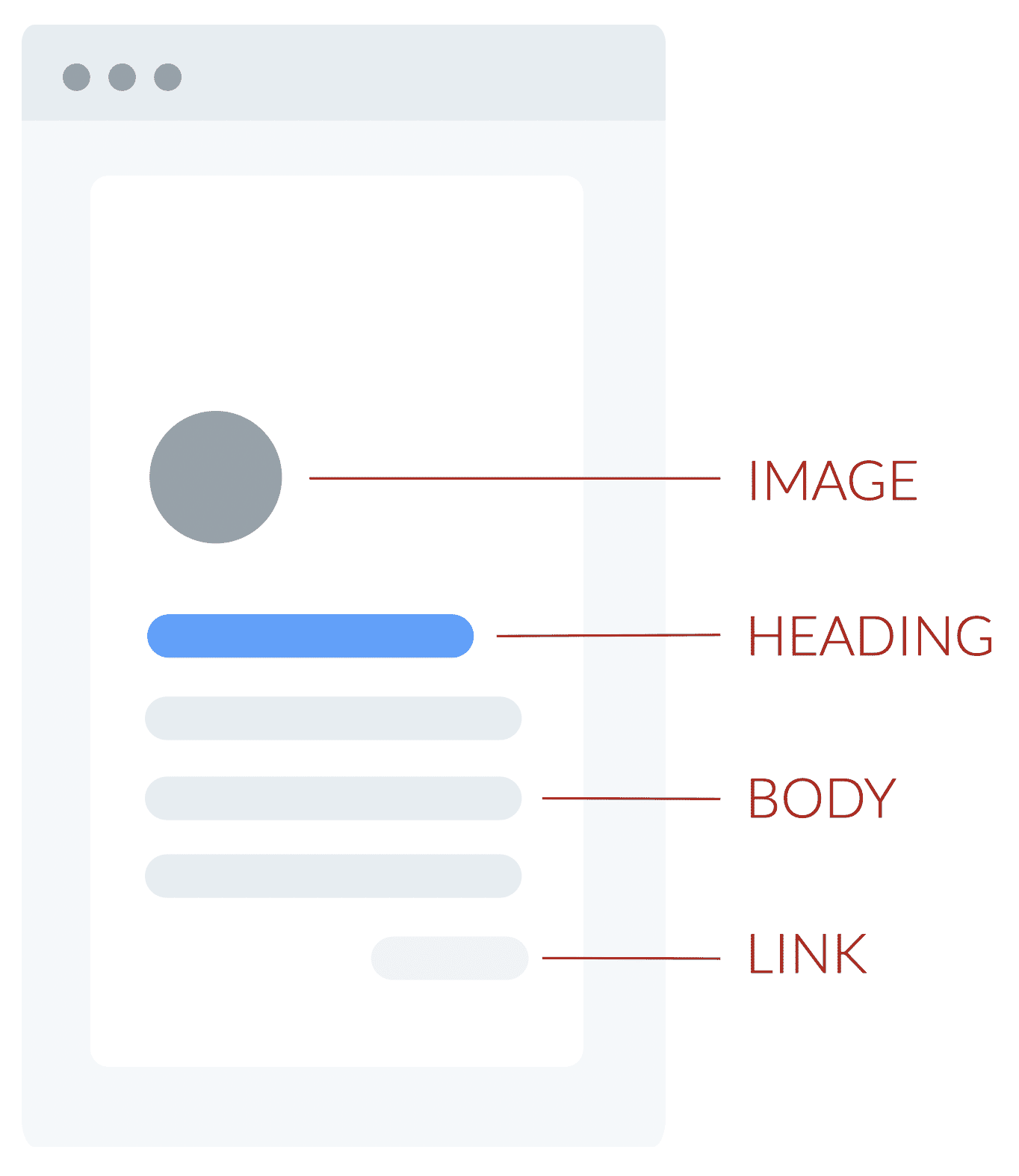
Structure your pages around a series of content blocks to aid scanability.
Each block consists of the following elements:
- A heading that summarises the content of the block.
- The content of the block, which should focus on communicating a single message.
- Links to additional information (optional).
- A visual to support the copy (optional).
Ensuring People Understand and Remember Your Website Copy
When distracted, stressed or failing to give a website our full attention, we all experience cognitive overload. Also, there is a high chance a website visitor may not speak English as their first language or have some form of cognitive disability (e.g. dyslexia).
Therefore, it is critical to ensure content is as easy to process as possible if we wish people to remember our message.
To make your content more accessible for everybody:
- Use plain language. The kinds of words we use in everyday conversation.
- Use numbers like 1 and 2 instead of writing the numbers out – like one or two.
- Write in short sentences. Include only one idea in every sentence.
- Use active language. For example write, “John loves Mary” not “Mary is loved by John”.
- Other than full stops use the smallest amount of punctuation possible.
- Use bullet points to break up difficult information. But keep your bullet points simple.
- Do not use jargon.
- Do not use abbreviations like “don’t”. Instead, write “do not”.
- Do not write too much. Think about what your reader must know.
Website Copywriting and SEO
How you approach website copywriting will have a significant impact on ranking.
What does not work
There is a lot of bad and out of date advice regarding how to rank on search engines, such as keyword stuffing. These techniques do not work and should be ignored. Also, do not believe suppliers who promise high ranking on search engines. This is not a promise they can guarantee.
What does work
Search engines are seeking to connect their users with the most relevant and useful content. As a result, the single most important thing you can do is ensure that your content is relevant and useful. The search engine will do the rest.
To achieve this we recommend:
- Have a clear idea of who your audience is and what they are likely to search on (what keyword phrase).
- Write content in areas that are relatively poorly covered by reputable sources. It will be hard to rank well on a popular subject that has been thoroughly covered by other well-respected publications.
- If your subject area has been covered extensively, focus on a specific element of the subject matter. For example, instead of attempting to rank well on “plastic pollution“, write about “the impact of business on plastic pollution“.
- Make it clear to the reader what the topic of the page is about.
You can achieve this last point by ensuring:
- The headings used in the copy, reference related keywords.
- The subject is clearly communicated upfront by including relevant keywords.
- Imagery relates to the subject matter, and alternative descriptions reflect this fact.
When publishing content
You can further enhance your chance of ranking well, by taking the following actions when publishing your content:
- Ensure the page title clearly indicates the topic of the page.
- Complete all SEO related fields in your content management system.
- Add links to the new content wherever appropriate across the rest of your website, and ensure that these links make the subject matter of the new page clear.
After publishing
Search engines judge the relevancy of content by how many sites link to that content and their reputation. For example, search engines will value a link from the BBC more than a local business.
That means one of the most important steps you can take to increase your content profile is to encourage others to link to it and attempt to gain ‘quality links’ from reputable websites.
There are many ways you can encourage another site to link to your content, including:
- Simply asking.
- Writing an article for related sites referencing your content.
- Providing a quote to include in articles on related sites.
- Promoting your content on social media.
- Promoting your content on related forums.
- Asking site owners to replace out of date or dead links with a link to your content.
Some applications can help with the monitoring and improvement of search engine rankings. However, ultimately, your ranking’s success will depend on the quality of content and who links to it.
Website Copywriting is An Enormous Undertaking
As you can see, writing the copy for your website is a complicated and time-consuming exercise that people regularly under-estimate. It is also not an exercise that is complete simply because your website has been launched. You will need to continue to refine it post-launch to ensure it as effective as possible.
Leave ample time to create and manage your content or seek out a professional copywriter to guide you through the process.


